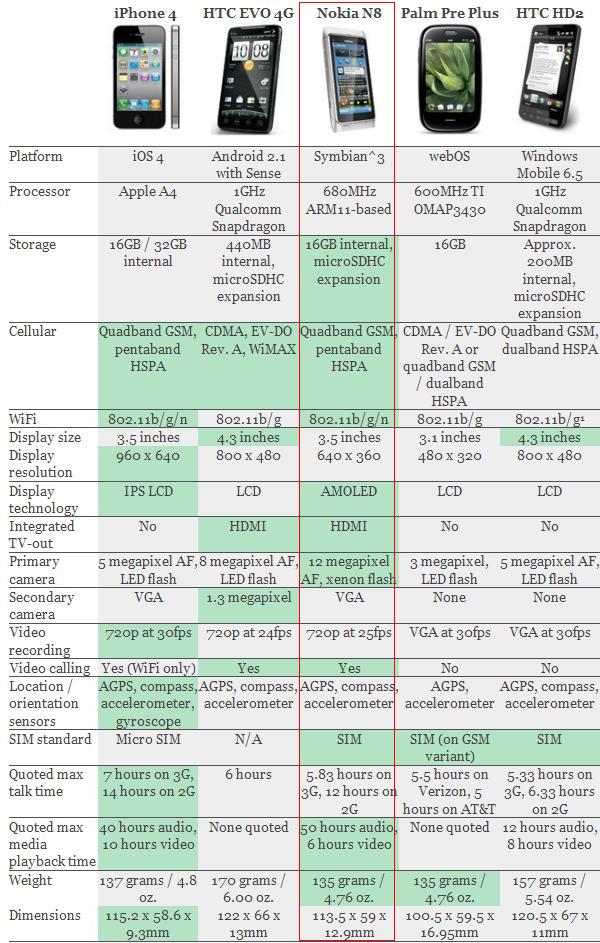
1) Great processing power based on modern processors. Androids use Cortex-A8 based processors which deliver a much better performance than Symbians with Arm 11 CPUs. Excellent examples are HTC Snapdragons (currently with 2nd generation) and Samsung Hummingbirds, both running at 1 GHz speed (versus 680MHz speed in Symbians). The gap in processing power is even larger with the newest dual-core CPUs based on Cortex-A9 architecture (like in Motorola Atrix). That makes Symbians to fall even farther behind Androids.
2) Screen resolution. Androids use higher screen resolutions with 800(854)x480 compared to Symbians (640x360). This allows more details to be displayed on screen, which is especially handy with web browsing (the extra information on screen saves the trouble to scroll too much). Furthermore, the recently announced Atrix brings even a higher qHD resolution (960x540)! That means 2.25 times more pixels on the phone display than those found in Symbian phones.
3) Memory (RAM). Everyone hates when the applications in a phone start to crash because of low memory. While 512MB RAM is normal for Androids, Symbians have to leave with 256MB RAM. Despite Nokia trying to optimize the memory usage, “out of memory” messages still happen in Symbian phones. On the contrary, some Androids reward you with even more RAM (768MB in Desire HD, 1GB in Atrix).
4) Graphics and games. Symbian devices use the Broadcom BCM2727 GPU, which while seems to perform pretty well against the old Adreno 200 chips (Nexus One), it falls behind the newest Android GPUs. Current Android devices come with powerful GPUs based on Adreno 205 (Desire HD) or PowerVR SGX540 cores. Furthermore, the newest Nvidia Tegra 2 chips bring even further boost in graphics performance, that is said to show 3-4 times better performance than Adreno 205 or SGX540! Nvidia has opened a special portal called Tegra Zone, where the owners of Android Tegra 2 devices can enjoy high quality gaming (as Nvidia describes the chip: "capable of extreme multitasking with the first mobile dual-core CPU, hardware accelerated Flash, and console-quality gaming with an ultra-low power GeForce GPU).
5) UI and customization. It has been pointed out by many analysts that Nokia UI is not modern enough to compete with Android/iOS. The limited customization of the homescreens and deep menus are all weaknesses of Symbian. On contrary, Androids offer huge customization of homescreens, menus, launchers, widgets that will satisfy vast majority of tastes. Either go with manufacturer customized UI (like HTC Sense with its 7 homescreens and widgets) or create a new one completely suited to your tastes. Popular launchers like Launcher Pro or ADW Launcher are handy to create customized UIs.
2) Screen resolution. Androids use higher screen resolutions with 800(854)x480 compared to Symbians (640x360). This allows more details to be displayed on screen, which is especially handy with web browsing (the extra information on screen saves the trouble to scroll too much). Furthermore, the recently announced Atrix brings even a higher qHD resolution (960x540)! That means 2.25 times more pixels on the phone display than those found in Symbian phones.
3) Memory (RAM). Everyone hates when the applications in a phone start to crash because of low memory. While 512MB RAM is normal for Androids, Symbians have to leave with 256MB RAM. Despite Nokia trying to optimize the memory usage, “out of memory” messages still happen in Symbian phones. On the contrary, some Androids reward you with even more RAM (768MB in Desire HD, 1GB in Atrix).
4) Graphics and games. Symbian devices use the Broadcom BCM2727 GPU, which while seems to perform pretty well against the old Adreno 200 chips (Nexus One), it falls behind the newest Android GPUs. Current Android devices come with powerful GPUs based on Adreno 205 (Desire HD) or PowerVR SGX540 cores. Furthermore, the newest Nvidia Tegra 2 chips bring even further boost in graphics performance, that is said to show 3-4 times better performance than Adreno 205 or SGX540! Nvidia has opened a special portal called Tegra Zone, where the owners of Android Tegra 2 devices can enjoy high quality gaming (as Nvidia describes the chip: "capable of extreme multitasking with the first mobile dual-core CPU, hardware accelerated Flash, and console-quality gaming with an ultra-low power GeForce GPU).
5) UI and customization. It has been pointed out by many analysts that Nokia UI is not modern enough to compete with Android/iOS. The limited customization of the homescreens and deep menus are all weaknesses of Symbian. On contrary, Androids offer huge customization of homescreens, menus, launchers, widgets that will satisfy vast majority of tastes. Either go with manufacturer customized UI (like HTC Sense with its 7 homescreens and widgets) or create a new one completely suited to your tastes. Popular launchers like Launcher Pro or ADW Launcher are handy to create customized UIs.
There are 7 other reasons that make Android a better OS than Symbian. Click here to read them.




 Yesterday the screen shots of Nokia upcoming Symbian 4 UI leaked and they were all over the Internet. Nokia had already showed some of the 2010 improvements that would be coming to Symbian as a Smart phone OS in December 2009. The improvements talk about a capacitive OS, multi-touch capabilities. Less efforts to open up common apps related to music, messaging, e-mail etc. For Symbian 4's development will be complete by Q3 2010 and Nokia will be churning out Symbain 4 based devices in 2011. For Symbian 4 nokia has focused on enhanced navigation capabilities, optimization of applications to support next generation graphics with transparency and transitions. As promised by Nokia last year, the UI will be simplified, graphically appealing, faster than its predecessors and yeah there will be multi-touch gesture support. In the images above you can see some changes like the transparent bars, enhanced widgets. The changes are subtle but they are appealing and give the UI a new look. I guess now Nokia is talking about taking its competition, especially in the touch screen space, head-on. If you check out the "
 The geeks over at Nokia Beta Labs have launched one more app that finds music based on your location. Aptly named as the





